
Landrace Strains: Hindu Kush & Lamb’s Breath Origins

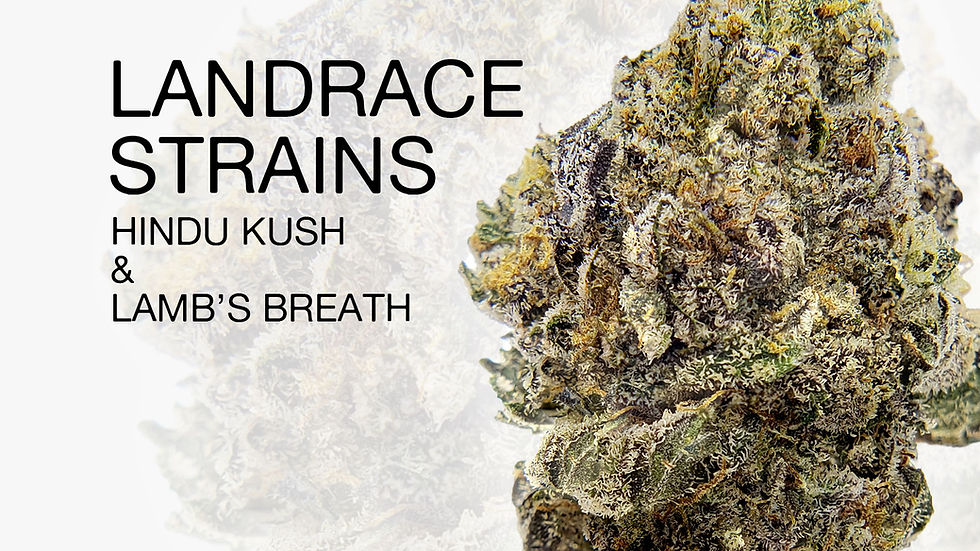
Before hybrids, before seed banks, before the global cannabis industry—there were landraces. These pure genetic lineages evolved over centuries in specific geographic regions, adapting to local climates and cultivation practices until they became distinct varieties. Understanding landraces means understanding where all modern cannabis genetics began.
Two legendary landraces—Hindu Kush and Lamb’s Breath—represent opposite ends of the cannabis spectrum while sharing the same ancient heritage: they’re the real thing, unchanged by modern breeding.
What Makes a Landrace?
Landrace strains share several characteristics:
· Geographic specificity: Evolved in one region over many generations
· Genetic stability: True-breeding—seeds produce plants like their parents
· Adaptation: Optimized for local climate, altitude, and day length
· Cultural integration: Traditional cultivation practices shaped their development
· Pure lineage: Unaltered by deliberate crossing with other varieties
Landraces are living history—genetic time capsules from before cannabis went global.
Hindu Kush: The Mountain Indica
Hindu Kush originates from the mountain range spanning Afghanistan and Pakistan—one of the harshest environments where cannabis grows naturally. Plants evolved to survive cold nights, intense UV radiation, and limited water.
The result is the prototypical indica: short, dense, resinous, and profoundly sedating.
Physical characteristics: - Compact, bushy structure (rarely exceeding 5-6 feet) - Broad, dark green fan leaves - Dense, tightly-packed buds - Heavy trichome production (evolved for UV protection)
Effects: - Deep physical relaxation - Sedating, especially at higher doses - Minimal cerebral activity - Classic “couch-lock” potential
Aroma/Flavor: - Earthy, woody base - Sweet hash notes - Subtle spice and sandalwood - The smell of traditional hashish
Growing notes: - Highly resilient - Short flowering period (7-8 weeks) - Tolerates cold and drought - Compact size suits indoor growing - Heavy resin production makes it ideal for concentrates
Hindu Kush is the genetic foundation for nearly every indica hybrid that followed. OG Kush, despite its name, carries Hindu Kush heritage. So do Master Kush, Purple Kush, and countless others.
Lamb’s Breath: The Caribbean Sativa
Lamb’s Breath (also spelled Lamb’s Bread) comes from Jamaica, where it developed in tropical conditions opposite to the harsh mountains of Hindu Kush. The warm, humid climate and long growing seasons allowed sativas to reach their full expression.
Legendary for being Bob Marley’s reported favorite strain, Lamb’s Breath embodies Caribbean cannabis culture.
Physical characteristics: - Tall, lanky structure (can exceed 12 feet outdoors) - Narrow, light green fan leaves - Airy, elongated bud structure - Moderate trichome coverage
Effects: - Energetic, uplifting cerebral high - Creative stimulation - Clear-headed functionality - Spiritual or introspective qualities (Rastafarian traditions emphasize its meditative use)
Aroma/Flavor: - Sweet and herbal - Fresh grass and hay notes - Hints of cheese (the Jamaican “cheesy” phenotype) - Light and refreshing
Growing notes: - Requires patience (12-14 week flowering) - Needs space—significant vertical growth - Prefers warm, humid conditions - Lower yields by weight than indica - Traditional outdoor cultivation in Jamaica
The Spectrum of Cannabis
Hindu Kush and Lamb’s Breath illustrate why indica and sativa classifications exist. They represent genuinely different evolutionary paths:
Factor | Hindu Kush (Indica) | Lamb’s Breath (Sativa) |
Origin climate | Cold mountains | Tropical |
Plant structure | Short, bushy | Tall, lanky |
Flowering time | 7-8 weeks | 12-14 weeks |
Effects | Sedating, physical | Energizing, cerebral |
Traditional use | Evening, hashish | Daytime, spiritual |
Flavor | Earthy, hash | Sweet, herbal |
Modern hybrids blend these characteristics, but experiencing pure landraces reveals the extremes they balance between.
Why Landraces Matter Today
In an industry dominated by hybrids, landraces serve several important purposes:
Genetic diversity: Breeding programs need diverse genetic material. Landraces provide traits that don’t exist in heavily-crossed modern strains.
Predictable effects: Pure landraces offer consistent experiences. Hindu Kush always sedates; Lamb’s Breath always energizes. Hybrids can be less predictable.
Cultural connection: These strains carry history. Smoking Lamb’s Breath connects you to Jamaican cannabis culture; Hindu Kush connects you to ancient Afghan hash traditions.
Preservation: Without cultivation, landraces face extinction. Growers who maintain pure lines protect irreplaceable genetics.
Finding Authentic Landraces
True landraces are increasingly rare. Seeds labeled “Hindu Kush” or “Lamb’s Breath” may be several generations removed from original genetics, or crossed with other strains.
For authentic landrace experiences: - Seek reputable seed banks specializing in heritage genetics - Look for documentation of seed origins - Expect variation—landraces aren’t as stabilized as commercial hybrids - Grow multiple plants to find optimal phenotypes
The effort is worthwhile. Experiencing a true landrace is tasting cannabis history.


This was such an insightful read! Everything you touched upon regarding landrace strains really resonates with my own observations over the years. It’s refreshing to see such a clear and accurate depiction of their unique qualities https://bots.ondiscord.xyz/lists/grQYPEM7i I particularly appreciated your point about their inherent resilience; it’s something I've noticed firsthand when working with older genetics. Honestly, I expected this topic to be a bit niche, but you’ve made landrace strains so compelling. I can already see this influencing many future discussions I have https://www.betstop.gov.au/ It’s rare to come across a piece that feels so definitive, and I’m confident this is the correct take on landrace strains. It makes me wonder about the potential for further cultivation and preservation efforts.…
This was such a lowkey, well-written take on landrace strains. Honestly, reading this really resonated with me. I’ve been curious about exploring them more, but it often feels like there's a lot of gatekeeping or just overwhelming information out there. The insights you shared about their unique characteristics and history would have saved me months of trial and error when I first started delving into this world https://www.utas.edu.au/ I remember my early attempts being so haphazard, trying to piece together information from disparate sources. An honest assessment of the difficulty involved, like you provided, is crucial for setting realistic expectations, something I definitely wish I'd had. This is getting bookmarked for sure; you've earned a dedicated reader with this thoughtful…
This was such an insightful read, and I'm already passing it along to a couple of friends who will absolutely love it. The deep dive into landrace strains like Hindu Kush and Lamb's Breath really resonated with me. It's truly awesome to see such a thorough exploration of these foundational varieties https://www.freetv.com.au/ It got me thinking about how one actually balances the theoretical knowledge of these landraces with the practical realities of cultivating them. For example, understanding their historical environment is one thing, but then translating that into a modern growing setup, considering factors like light spectrum or humidity, presents a whole different challenge. Everything you've discussed lines up so perfectly with my own experiences working with similar genetics, and…
This was a truly insightful read, thank you for putting so much care into it. It's fascinating how you've articulated the nuances of landrace strains, and I've actually come to very similar conclusions through my own explorations. The idea of preserving these genetic lines feels increasingly vital, especially with so much homogenization happening elsewhere https://www.theage.com.au/ It makes me reflect on how much traditional knowledge is tied to these original varieties. Filing this under my absolute must-read resources for anything related to landrace strains. The discussion on network effects surrounding them is particularly compelling; it highlights how communities and their practices are inseparable from these plants. It really makes you wonder about the long-term implications for biodiversity when we lose touch…
Hindu Kush, originating from the rugged mountains between Afghanistan and https://aifs.gov.au/ Pakistan, is known for its resilience and calming effects, while Lamb’s Breath, hailing from Jamaica, is cherished for its uplifting and energetic qualities. On The Pokies, I’ve seen some fascinating discussions about how these landraces have influenced modern hybrids and the importance of preserving their genetics. It’s incredible to think about how these ancient strains continue to shape the cannabis world, offering a glimpse into the plant’s rich history and natural evolution.